FY 2027 ICD-10-CM Updates: What Medical Coders Need to Know
FY 2027 ICD-10-CM Updates: What Medical Coders Need to Know
The FY 2027 ICD-10-CM code set is now in effect, bringing new diagnosis codes, deleted codes, revised entries, and targeted guideline changes that medical coders need to understand.
Understanding what changed, when a code should be reported, and how guidelines affect sequencing is vital to maintaining coding compliance and claim accuracy across all healthcare facilities.
The FY 2027 ICD-10-CM code set is now in effect, bringing new diagnosis codes, deleted codes, revised entries, and targeted guideline changes that medical coders need to understand.
Understanding what changed, when a code should be reported, and how guidelines affect sequencing is vital to maintaining coding compliance and claim accuracy.
The FY 2027 ICD-10-CM code set is now in effect, bringing new diagnosis codes, deleted codes, revised entries, and targeted guideline changes that medical coders need to understand.
The code set applies to healthcare services from October 1, 2026, through September 30, 2027. The update affects diagnosis coding across hospitals, physician practices, outpatient facilities, and other healthcare settings.
For medical coders, the annual update is not simply about memorizing new code numbers. The more important task is understanding what changed, when a code should be reported, and how the updated guidelines affect code selection and sequencing.
This article highlights important FY 2027 updates and what coders should review when working with the new code set.
What Changed in FY 2027 ICD-10-CM?
The FY 2027 update includes 190 new codes, 30 deleted codes, and 4 revised code titles, according to ACDIS’s summary of the official release .
You may also see a different figure from AAPC, which reports 238 new entries, 21 deleted entries, and 4 revised entries. The difference comes from counting methods. The 238 figure includes 48 non-billable category headers alongside the 190 billable codes.
For coders, the headline number matters less than the source files. Use the official CMS and CDC/NCHS FY 2027 files, including the Addendum, Tabular List, Alphabetic Index, and Official Guidelines, to determine which codes are valid and reportable.

Major FY 2027 ICD-10-CM Code Changes
Several new codes provide greater specificity for documented conditions across oncology, ENT, abdominal conditions, orthopedics, and genetics:
| Code | FY 2027 Description | Why It Matters |
|---|---|---|
| C78.31 | Secondary malignant neoplasm of larynx | Adds site-specific metastatic cancer coding |
| C78.32 | Secondary malignant neoplasm of pharynx | Adds greater specificity for the metastatic site |
| C79.83 | Secondary malignant neoplasm of oral cavity | Provides a specific code for this metastatic site |
| J34.830 | Odontogenic sinusitis, maxillary sinus | Adds site-specific sinusitis coding |
| K6A.01 | Prevesical abscess | Provides a specific code under the new pelvic disease category |
| M67.A01 | Plantar fasciitis, right foot | Adds laterality-specific coding |
| Z68.18 | Body mass index [BMI] 18.4 or less, adult | Adds specificity at the low end of adult BMI reporting |
| QA1.792 | Li-Fraumeni syndrome | Adds specificity for a genetic disorder associated with neoplasms |
These examples show how the update provides more detailed coding options in several clinical areas. Coders should still verify the documentation and the full Tabular List entry before assigning any code.
Watch the Code Structure
Some entries are categories or headers rather than final reportable codes.
For example, K6A.0 is the category for pelvic abscess. The reportable codes beneath it are:
- K6A.01: Prevesical abscess
- K6A.09: Other pelvic abscess
Review the complete code structure and Tabular List before assigning the final code.
Deleted Codes: The S23.420- Series
FY 2027 also deletes codes from the previous code set. One example is the S23.420- series, which represented sprain of the sternoclavicular (joint) (ligament). The deleted codes include:
- S23.420A: Initial encounter
- S23.420D: Subsequent encounter
- S23.420S: Sequela
The S23.420- series is no longer valid for FY 2027 dates of service.
Why Date of Service Matters
Always use the ICD-10-CM code set that applies to the date of service. A code that was valid through September 30, 2026, should not be carried forward to services provided on or after October 1, 2026.
When coding older services, corrected claims, or historical records, use the code set that applied on the original date of service. Reviewing a chart after October 1 does not change which code year applies.
Important FY 2027 Guideline Changes
The FY 2027 Official Guidelines contain a focused set of changes. The updates involve hypertension with heart disease, hypertensive crisis, genetic disorders, and diethylstilbestrol (DES) exposure. You can read the full document in the FY 2027 Official Guidelines (PDF) .
Other sections, including sepsis and cancer treatment, remain important to know well, so always work from the current guideline text rather than memory.
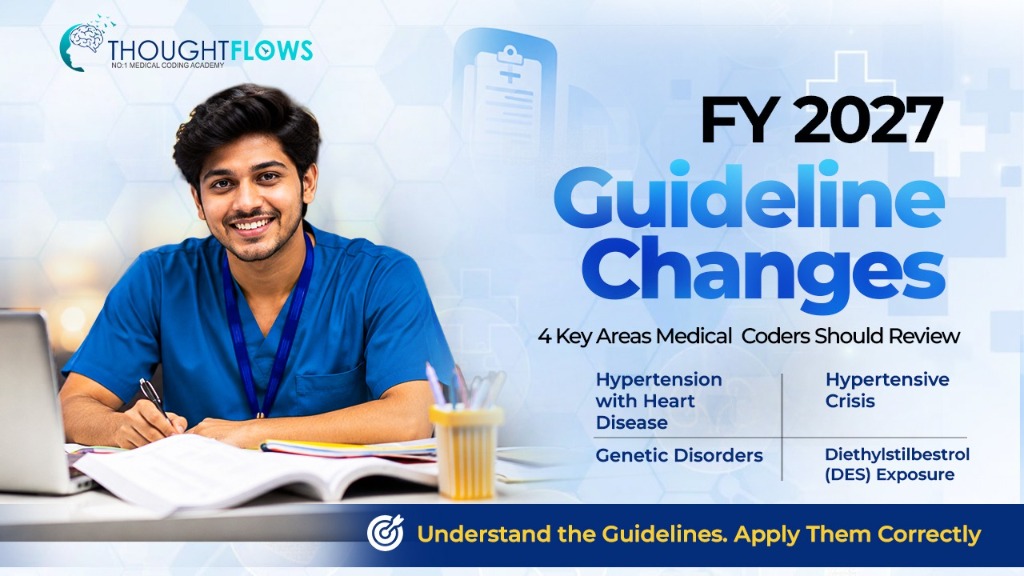
1. Hypertension With Heart Disease
The FY 2027 guidelines revise the wording for hypertensive heart disease to refer to hypertension with one or more heart conditions. This clarifies that category I11 applies when hypertension is documented with any one or more of the qualifying heart conditions, not only a single one.
Hypertension with heart conditions classified to the following is assigned to category I11, Hypertensive heart disease:
- • I50.-: Heart failure
- • I51.4: Myocarditis, unspecified
- • I51.89: Other ill-defined heart diseases
- • I51.9: Heart disease, unspecified
Use additional code(s) from category I50 or I51 to identify the heart condition.
Hypertension with I51.5 (Myocardial degeneration) or I51.7 (Cardiomegaly) is also assigned to category I11.
Important Exception: These same heart conditions (I50.-, I51.4-I51.7, I51.89, I51.9) are coded separately if the provider has documented that they are unrelated to the hypertension. Without that documentation, the classification presumes a relationship between the two.
2. Hypertensive Crisis
The guideline for hypertensive crisis has also been expanded. For documented hypertensive urgency, hypertensive emergency, or unspecified hypertensive crisis, assign a code from category I16, Hypertensive crisis.
Also code any identified hypertensive disease. The guideline now specifically includes I1A.-, Other hypertension, alongside categories I10 through I15. Sequencing depends on the reason for the encounter.
This matters when another form of hypertension, such as resistant hypertension, is documented together with a hypertensive crisis.
3. Genetic Disorders
The Chapter 17 title has been expanded to:
The guidelines direct coders to assign codes from Q00-QA1 when a congenital malformation, deformation, chromosomal abnormality, or genetic disorder is documented. The new QA1.- range covers genetic disorders associated with neoplasms not elsewhere classified, for example QA1.792, Li-Fraumeni syndrome.
This is particularly relevant to oncology, genetics, and hereditary-condition coding.
4. Diethylstilbestrol (DES) Exposure
The FY 2027 guidelines add instruction for two Z codes related to DES exposure:
Z84.A
Family history of exposure to diethylstilbestrol
Used when a family member’s DES exposure may place the patient at increased risk, such as when the patient’s maternal grandmother was exposed (third-generation exposure).
Z91.B
Personal risk factor of exposure to diethylstilbestrol
Used when the patient was directly exposed in utero, for example because the patient’s mother took DES during pregnancy.
The distinction coders need to make is whether the patient was directly exposed or has a family history of exposure.
Note: These are not two brand-new FY 2027 codes to memorize. Z84.A, for example, was added in the April 1, 2026 update, and the FY 2027 guidelines add instruction on applying it.
Other Notable FY 2027 Code Additions
The update contains many additional changes beyond the examples above. For instance, 33 new codes cover continuing pregnancy after vanishing twin syndrome, and 17 new codes cover the toxic effect of cycloparaffins (ACDIS ).
Other areas receiving new codes include:
This is why coders should review the complete annual update for their specialty rather than only the most widely discussed changes.
Common FY 2027 Coding Mistakes to Avoid

1. Using an outdated code
A code valid in FY 2026 may have been deleted, revised, or restructured for FY 2027. Always verify the code against the date of service.
2. Reporting a category instead of a complete code
A category or header may not be the final reportable code. For example, do not report K6A.0 when a more specific code such as K6A.01 applies.
3. Ignoring laterality or required characters
Some codes require additional specificity, such as right or left, or a 7th character. Confirm that the provider documentation supports the required level of detail.
4. Choosing a code without checking the Tabular List
The Alphabetic Index is only the starting point. Confirm the final selection in the Tabular List and review:
- Inclusion terms
- Excludes notes (Excludes1 and Excludes2)
- Code first and Use additional code instructions
- Code also instructions
- Required characters
- Other applicable notes
5. Relying on previous-year guidelines
A familiar diagnosis does not always mean the coding rules are unchanged. Review the FY 2027 Official Guidelines, particularly the sections affected by revisions.
How Medical Coders Can Prepare for FY 2027

Divide the annual update into three clear action areas:
1. New Codes
Identify the additions relevant to your specialty and daily coding work.
2. Guideline Changes
Review changes that affect code selection, sequencing, and documentation interpretation.
3. Deleted / Revised
Check frequently used codes and update coding references, cheat sheets, templates, and internal resources.
Most importantly: Apply the changes to real or sample clinical documentation. Understanding how a rule affects an actual medical record is far more useful than memorizing a list of code numbers.
Frequently Asked Questions
Final Takeaway
The FY 2027 ICD-10-CM update is more than a list of new diagnosis codes. It includes new and deleted codes, greater clinical specificity, and targeted guideline changes that can affect everyday coding decisions.
Pay particular attention to hypertension with heart disease, hypertensive crisis, genetic disorders, DES exposure, newly expanded diagnosis categories, and deleted code series.
The best approach is to review the new codes, check deleted codes against the date of service, understand the guideline changes, verify the Tabular List, and apply the updates to real clinical documentation.
Staying current with ICD-10-CM updates helps coders maintain accuracy, reduce avoidable errors, and support compliant reporting throughout FY 2027.
Build Your Medical Coding Skills With ThoughtFlows
Understanding ICD-10-CM updates is an important part of becoming a confident medical coder. To build practical coding knowledge and prepare for industry-recognized certification, explore the medical coding training and certification programs at ThoughtFlows Medical Coding Academy.
Table of Contents
- Introduction
- What Changed in FY 2027
- Major Code Changes
- Watch Code Structure
- Deleted Codes
- Why Date of Service Matters
- Important Guideline Changes
- Other Notable Additions
- Common Mistakes to Avoid
- How Coders Can Prepare
- Frequently Asked Questions
- Final Takeaway & Skills
Master Medical Coding
Learn ICD-10-CM, CPT, and HCPCS coding from industry experts at ThoughtFlows Medical Coding Academy.
View Courses
Enroll at Thoughtflows Medical Coding Academy for top-notch medical coding training. Our courses are designed to provide comprehensive education and practical experience, ensuring students become proficient and certified medical coders.
HEAD OFFICE