Certified AI Medical Coder: Why Your Next Interview Won't Ask a Single ICD-10 Question
Certified AI Medical Coder: Why Your Next Interview Won't Ask a Single ICD-10 Question
You’ve spent months learning ICD-10-CM, practicing coding guidelines, and preparing for certification. Now you’re sitting in a medical coding interview, expecting questions about code selection, sequencing, and specificity.
But instead, the interviewer asks: “An AI tool has suggested a code for this case, but something doesn’t look right. What would you do?”

You’ve spent months learning ICD-10-CM, practicing coding guidelines, and preparing for certification. Now you’re sitting in a medical coding interview, expecting questions about code selection, sequencing, and specificity.
But instead, the interviewer asks: “An AI tool has suggested a code for this case, but something doesn’t look right. What would you do?”
That is where the idea behind this title comes in.
The title is deliberately provocative. ICD-10-CM knowledge has not suddenly become unimportant. It remains the foundation that allows a coder to understand, question, and validate a coding decision.
What is changing is the technology around the work. AI and computer-assisted tools are being developed and used to support different parts of healthcare and coding workflows. Professional organizations such as AAPC are also providing education focused on critical thinking in AI-enabled coding environments.
For a Certified AI Medical Coder, the goal is not simply to know how technology works. It is to understand how coding knowledge can be applied when technology becomes part of the workflow.
How AI Is Entering Medical Coding
Medical coding starts with reviewing clinical documentation and identifying the diagnoses, procedures, and other information that needs to be coded.
AI and computer-assisted coding technologies can support parts of this process. Depending on the system, they may identify information in documentation, suggest possible codes, highlight information for review, or assist with code searches.
The exact capabilities vary between tools.
Consider a Simple Example:
In an outpatient setting, a medical record may state that a condition is being evaluated or ruled out. An automated system could identify the condition as a possible diagnosis and suggest a code.
The coder should not simply accept that suggestion because the condition appears in the note.
The documentation still needs to be reviewed against the applicable coding rules. For outpatient coding, conditions documented as “rule out,” “probable,” or “suspected” are generally not coded as confirmed diagnoses. The documented symptoms or other appropriate information are coded according to the applicable guidelines.
This shows why understanding coding principles is important even when technology is involved.
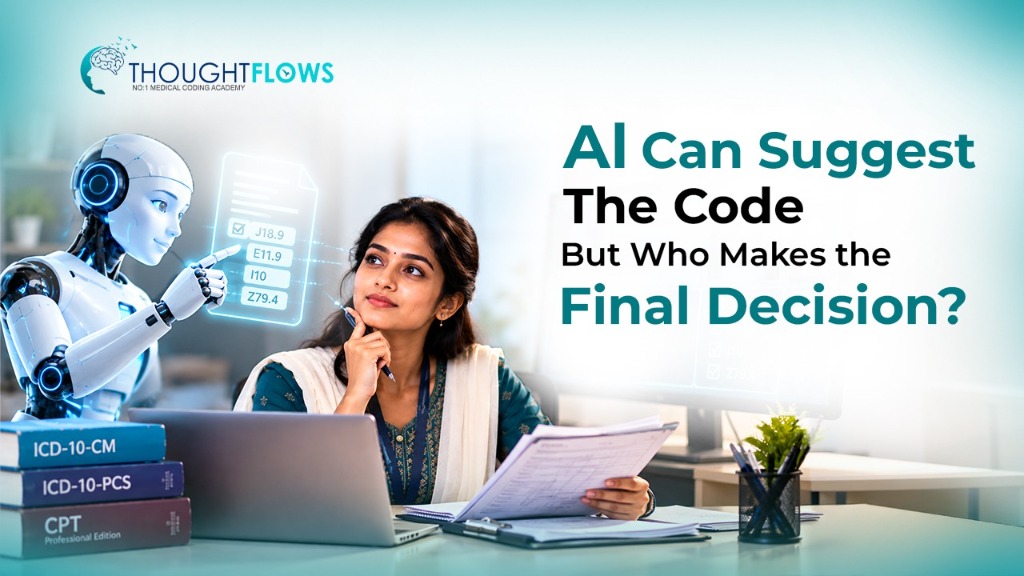
What Is a Certified AI Medical Coder?
A Certified AI Medical Coder can describe a medical coding professional who combines a traditional coding foundation with knowledge of AI-assisted coding workflows.
However, the phrase should not automatically be treated as one universal certification recognized by every healthcare organization.
Different organizations may offer their own AI-focused medical coding courses or credentials. Before choosing one, check the issuing organization, curriculum, examination requirements, and what the credential actually represents.
The skill set generally brings together two key areas:
Medical Coding Foundation
A strong coding foundation covers areas such as:
- ICD-10-CM
- CPT
- HCPCS
- Medical terminology
- Anatomy and physiology
- Coding guidelines
- Clinical documentation and compliance
AI-Assisted Coding Skills
The technology side can include:
- Understanding AI-assisted coding workflows
- Reviewing automated suggestions
- Identifying questionable results
- Comparing AI output with documentation
- Recognizing when further review is required
- Understanding responsible use of healthcare data
AI-focused learning should add to your existing coding knowledge rather than replace it.
Why ICD-10-CM Still Matters
If an AI system can suggest a code, why should a medical coder still learn ICD-10-CM?
“Because the technology proposes; the coder decides.”
Suppose an AI tool recommends a diagnosis code after analyzing a clinical note. The coder still needs to determine:
- Is the diagnosis actually documented?
- Does the documentation support the code?
- Is the code sufficiently specific?
- Are the applicable guidelines being followed?
- Is the sequencing correct?
Without understanding ICD-10-CM, it becomes difficult to evaluate the suggestion properly.
Computer-assisted coding has long involved technology generating coding output that requires review. AHIMA has also discussed the development and role of computer-assisted coding in professional coding workflows. Reference: AHIMA Journal – Computer-Assisted Coding
For someone pursuing a Certified AI Medical Coder path, ICD-10-CM therefore remains an important part of the foundation.
Skills That Matter Beyond Code Selection
AI-focused medical coding is not about becoming a software developer. Several professional skills become useful when technology is part of the workflow.
1. Critical Thinking
Don't accept an automated suggestion simply because a system produced it. Compare the result with the documentation and applicable coding rules.
2. Documentation Review
Read the record carefully and identify information that is missing, unclear, conflicting, or insufficient for the coding decision.
3. Technology Adaptability
Coding platforms and workflows can differ between organizations. Being comfortable learning new systems can help you adjust to changing work environments.
4. Communication
If a suggested code does not match the documentation, you should be able to explain the issue clearly to the appropriate person and follow the organization's correction or escalation process.
5. Privacy Awareness
When working with healthcare information and digital tools, follow your organization's privacy and security requirements. Where HIPAA applies, access and use of protected health information should follow applicable HIPAA requirements, including the minimum-necessary standard where appropriate.
What to Look for in AI Medical Coding Certification
If you are searching for AI Medical Coding Certification, don't choose a program simply because “AI” appears in its name.
Look at the actual curriculum.
A useful program should connect AI concepts with medical coding rather than treating them as completely separate subjects.
Check whether the program covers:
- Medical coding fundamentals
- ICD-10-CM and other major code sets
- Coding guidelines
- Clinical documentation
- AI-assisted coding concepts
- Reviewing technology-generated suggestions
- Practical coding scenarios
- Compliance and responsible technology use
Also check who issues the credential, whether an examination is involved, and what the certification is intended to demonstrate.
If the program leads to a specific credential, understand exactly what that credential represents and whether it matches your career goals.
7 AI-Related Medical Coding Interview Questions
If you're preparing for an AI-focused medical coding interview, don't prepare only for questions that ask you to identify a code.
Be ready to explain how you reached your decision.
1. An AI tool suggests a code that you believe is incorrect. What would you do?
Go back to the clinical documentation, check the applicable coding guidelines, and compare the suggestion with the documented information. If it is not supported, explain the discrepancy and follow the organization's correction or escalation process.
2. How would you validate an AI-generated code?
Review the documentation first, verify the diagnosis or procedure, check the relevant coding guidelines, and confirm that the final code accurately represents what is documented.
3. What would you do if the documentation is incomplete?
Identify what information is missing and follow the appropriate clarification process. If a provider query is required under the organization's procedures, the query should be based on the documentation and should not lead the provider toward a particular answer.
4. What if an AI system repeatedly produces the same coding error?
Document the recurring issue, verify the pattern, and report or escalate it through the appropriate organizational process rather than silently correcting the same error every time.
5. How would you handle conflicting information in a medical record?
Review the relevant documentation, apply the applicable coding guidelines, and seek clarification through the appropriate process when the record does not provide enough information for a supported coding decision.
6. How do you keep your coding knowledge current?
Regularly review coding updates, professional education, official guidance, and practice cases. Continuing education is important because both coding requirements and technology can evolve.
7. How would you handle patient information while using an AI-enabled tool?
Use only approved systems and follow the organization's privacy and security policies. Where HIPAA applies, protected health information should be handled according to HIPAA requirements, including applicable minimum-necessary principles.
A Strong Answer Example
If the interviewer gives you an AI-generated code that appears incorrect, you could answer:
“I would first review the clinical documentation to confirm what is actually documented. Then I would check the applicable coding guideline and sequencing requirements. If the suggestion is not supported, I would not use it simply because the system generated it. If the documentation is unclear, I would follow the appropriate clarification process.”
This answer demonstrates coding knowledge, judgment, and a practical approach to using technology.
How to Prepare for an AI-Assisted Coding Interview
You don't need to become an AI specialist to prepare for this type of interview.
Focus on four areas:
1. Strengthen Your Coding Knowledge
Be comfortable with the coding principles you have already learned. Technology skills work best when your understanding of coding is strong.
2. Practice Documentation-Based Cases
Work through clinical scenarios and explain why a particular coding decision is appropriate rather than relying only on code memorization.
3. Understand AI-Assisted Workflows
Learn the basic role of AI and computer-assisted tools in coding. You don't need programming knowledge to understand how these systems can support a coder's work.
4. Practice Explaining Your Reasoning
Instead of answering only: “I would choose this code.”
Explain: “I would choose this code because the documentation supports it and the applicable guideline allows it. I would also check the relevant sequencing and specificity requirements before finalizing the result.”
Clear reasoning helps the interviewer understand how you approach a coding decision.
For a Certified AI Medical Coder, this ability to explain the reasoning behind a decision can be just as important as knowing how to use a technology-assisted tool.
What Does This Mean for Future Medical Coders?
AI is becoming part of the wider conversation around healthcare technology and coding workflows. AAPC, for example, provides education focused on critical thinking for medical coders working in AI-enabled environments. Reference: AAPC – Critical Thinking for Medical Coders
For someone entering medical coding, the practical takeaway is simple:
Build strong coding knowledge first, then learn how technology fits into the work.
The future of medical coding is not about choosing between coding expertise and technology. It is about understanding how both can work together while maintaining accurate and compliant coding practices.
Frequently Asked Questions
Prepare for the AI-Enabled Future of Medical Coding
Medical coding continues to combine clinical documentation, coding standards, professional judgment, and technology.
If you're beginning your medical coding career or looking to strengthen your skills, explore ThoughtFlows' medical coding training programs to build your coding foundation and prepare for certification and career opportunities.
For aspiring Certified AI Medical Coders, developing strong coding fundamentals alongside an understanding of AI-assisted workflows can provide a practical foundation for adapting to technology-driven changes in the field.
Build your coding knowledge. Understand the technology. Be ready to adapt.
Table of Contents
- Introduction
- How AI Is Entering Medical Coding
- What Is a Certified AI Medical Coder?
- Why ICD-10-CM Still Matters
- Skills Beyond Code Selection
- What to Look for in Certification
- 7 AI-Related Interview Questions
- How to Prepare for an Interview
- What This Means for Future Coders
- Frequently Asked Questions
- Prepare for the AI-Enabled Future
Want to learn AI Medical Coding?
Explore our certified training programs tailored for the AI-assisted healthcare industry.
Explore Courses
Enroll at Thoughtflows Medical Coding Academy for top-notch medical coding training. Our courses are designed to provide comprehensive education and practical experience, ensuring students become proficient and certified medical coders.
HEAD OFFICE